





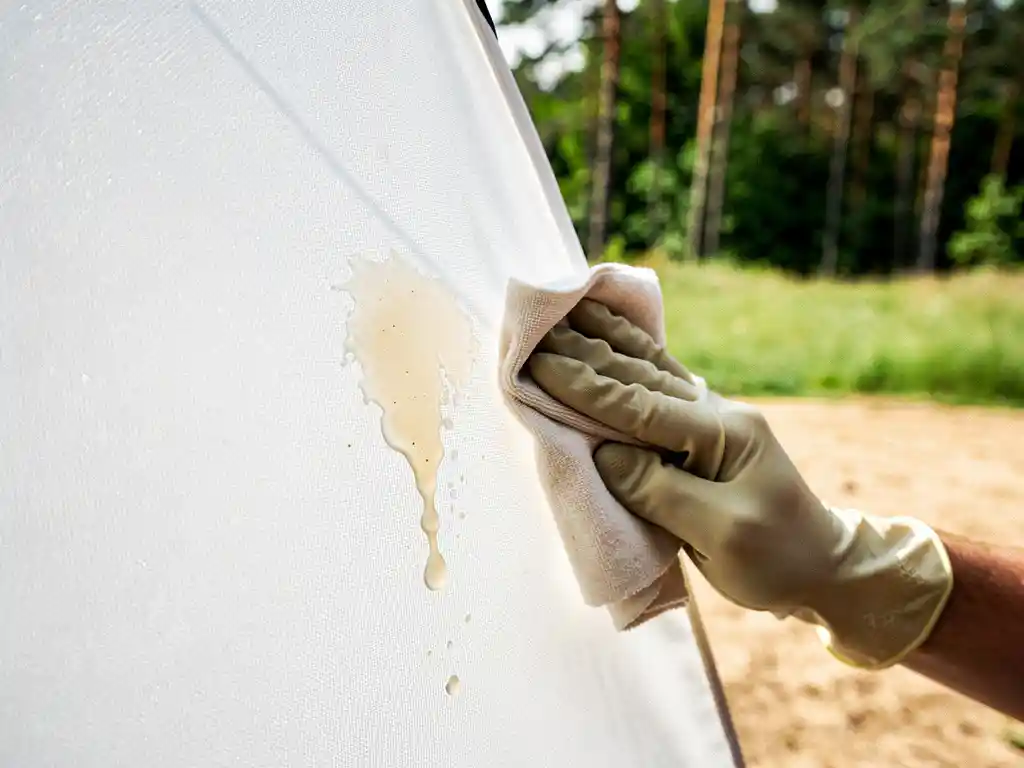
To remove bird droppings from a tent fabric, first allow the stain to dry, then scrape it off and treat it with a suitable tent shampoo or a mild cleaner. Fresh stains are easier to remove than dried-on ones, but even stubborn residues can be dealt with effectively using the right approach.
Bird droppings contain acids and enzymes that can damage the fabric if left on for too long. The quicker you act, the less damage the stain will cause. In this article, we answer the most frequently asked questions about dealing with bird droppings on tent fabric.
Why is bird droppings so damaging to tent fabric?
Bird droppings are harmful to tent fabric because they contain uric acid and other organic substances that can break down the fibres of the material. This chemical reaction begins shortly after contact with the fabric and worsens the longer the stain remains, particularly in the heat and sunlight.
Canvas, polyester and nylon are all susceptible to damage from acids. In the case of canvas, the coating can be damaged, causing the fabric to lose its water-repellent properties. In the case of polyester and nylon, the fibres can weaken, leading to tears or discolouration in the long term.
As well as causing chemical damage, bird droppings also retain moisture, which can encourage mould growth. That’s another reason not to leave stains, especially if you’re packing the tent away without cleaning it thoroughly.
How do you remove fresh bird droppings from a tent?
The best way to remove fresh bird droppings is to first let the stain dry until it is no longer sticky, then carefully scrape away the coarse bits with a blunt object such as a plastic spatula, and finally clean the area with lukewarm water and a soft brush.
Do not rub the wet stain straight away, as this will work the dirt deeper into the fibres. By waiting a moment until the stain has dried, you can remove most of it without damaging the fabric. You can then proceed as follows:
- Carefully scrape away the dry residue with a plastic spatula or the back of a spoon.
- Rinse the area with lukewarm water to remove any loose particles.
- Apply a small amount of tent shampoo to the stain and work it in with a soft brush.
- Rinse thoroughly with clean water and leave the fabric to air-dry.
Do not use hot water, as this may damage the coating on the fabric. Lukewarm or cold water works perfectly well and is safer for the material.
Ready for your next adventure?
Discover Rokimi’s professional cleaning and protection products and keep your tent fabric, awnings, boat covers and other outdoor equipment looking good for longer.
- ✓ Professional formula
- ✓ Specialist in cleaning & protection
- ✓ Certified quality
How do you remove dried bird poo stains from a tent?
To remove dried-on bird droppings, first soak the stain in lukewarm water, gently loosen the residue, and then use a stronger cleaner that penetrates deep into the fibres. Ordinary shampoo is often not enough for stubborn stains.
Leave the stain to soak for a few minutes before you start scrubbing. This will soften any dried-on residue and prevent you from having to scrub too hard, which could damage the fabric. For stains that have been there for some time or have caused discolouration, a heavy-duty cleaner is the best choice.
Always work in circular motions using a soft brush, and rinse thoroughly in between to see if the stain has disappeared. Repeat the treatment if necessary. Some old stains leave a slight discolouration which is difficult to remove completely, even with the strongest cleaner.
Which cleaning products are safe for tent fabric?
Safe cleaning products for tent fabric are those specifically designed for outdoor textiles, such as tent shampoos and specialised cleaning products for canvas, polyester and nylon. Household cleaning products such as washing-up liquid, bleach or all-purpose cleaner are not recommended.
Household products often contain harsh chemicals that can damage the water-repellent coating on the fabric or cause the colour to fade. Even mild soap can damage the waterproofing if used frequently.
What to look out for when choosing a cleaning product for tent fabric:
- Suitable for the following material: Check whether the product works on canvas, polyester or nylon.
- No bleach or solvents: These damage the fibres and the coating.
- pH-neutral or slightly acidic: This is the gentlest method for most types of fabric.
- Ready to use: Products that do not need to be diluted are easier to use and produce more consistent results.
For light soiling, a standard tent shampoo will do. For stubborn stains such as dried-on bird droppings, mould or mud, you’ll need a more powerful cleaner that penetrates deep into the fibres.
Do you need to re-waterproof a tent after cleaning it?
Yes, after thoroughly cleaning a tent fabric, it is strongly recommended that you re-waterproof it. Cleaning, however careful it may be, reduces the fabric’s water-repellent properties. Without a follow-up treatment, the tent loses its protection against rain and damp.
The water-repellent coating on tent fabric wears away not only through use, but also through cleaning. Even if you use a product that is suitable for tent fabric, the waterproofing becomes slightly less effective with every wash. This is normal and is part and parcel of looking after outdoor textiles.
A good rule of thumb is: always clean the tent thoroughly before waterproofing it. Applying waterproofing to a dirty fabric is of little use, as the product cannot penetrate the fibres properly. For best results, allow the fabric to dry completely after cleaning before applying the waterproofing treatment.
How can you prevent bird poo stains on your tent?
You can never completely prevent bird droppings from staining your tent, but you can significantly reduce the risk by being careful about where you pitch your tent and how you store it. Acting quickly when a fresh stain appears also prevents most of the damage.
Practical tips for minimising damage caused by bird droppings:
- Avoid camping under trees where there are lots of birds, such as poplars, oaks and fruit trees.
- Don’t pack your tent away whilst it’s dirty. Stains that remain on a tent that has been in storage for months are much more difficult to remove.
- Check the tent regularly whilst on a camping trip, and remove fresh stains straight away.
- Use a good water-repellent treatment so that dirt is less likely to be absorbed into the fibres and is easier to rinse out.
A well-impregnated fabric not only offers protection against rain, but also ensures that bird droppings do not penetrate as deeply into the material. This makes cleaning a lot easier.
How Rokimi helps remove bird droppings from tent fabric
Here at Rokimi, we have developed our product range specifically for situations like this: stubborn stains on outdoor fabrics that cannot be removed with ordinary household cleaning products. Our products are ready to use, work deep into the fibres and are safe for canvas, polyester and nylon.
Here’s how our products can help you remove bird droppings from tent fabric:
- Hood & Tent Shampoo: Ideal for fresh stains and regular maintenance. Effectively removes light soiling without damaging the coating.
- Heavy Duty Cleaner: the ideal choice for dried-on stains and stubborn dirt that has penetrated deep into the fibres.
- Hood & Tent Protection: the most effective waterproofing agent of its kind, which fully restores the water-repellent properties after cleaning.
Together, these three products form a complete care routine for your tent. Take a look our full product range or find out which applications for which our products are suitable. Ready to get your tent back into top condition? Go to rokimi.com and order straight away.
Everything you need for a clean and protected outdoor lifestyle.
Discover Rokimi’s range of professional cleaning and protection products.
VIEW ALL PRODUCTS →Frequently Asked Questions
Can I remove bird droppings from a tent fabric using a high-pressure washer?
A high-pressure washer is not recommended for tent fabric, as the powerful jet of water can damage the coating and the fibres. The pressure can also weaken seams and stitching, causing leaks. It is better to use a soft brush with lukewarm water and a suitable tent shampoo for a safe and effective result.
How long can I wait before treating a bird poo stain on my tent?
The sooner you act, the better — but do let the stain dry a little first before removing it, so that you can scrape off the coarse bits. Never wait longer than a day or two, as the acids in bird droppings quickly start to damage the fibres, especially in warm or sunny weather. Dried-on stains that remain for weeks or months can cause permanent discolouration or structural damage.
What should I do if the bird droppings have left a white or yellow stain?
Any discolouration remaining after cleaning is often caused by uric acid that has already been absorbed into the fibres. Try treating the stain again with a heavy-duty cleaner and leave the product to work for a little longer before rinsing it off. Bear in mind that very old stains can sometimes leave a slight discolouration that won’t disappear completely, even with the strongest cleaner.
Can I wash my tent in the washing machine to remove bird poo stains?
Washing a tent in the washing machine is generally strongly discouraged, unless the manufacturer explicitly permits it. The mechanical action of the drum, combined with detergent residues, causes serious damage to the coating and the waterproofing. Hand washing with a suitable tent shampoo and a soft brush is always the safest and most effective method.
Do I need to clean the whole tent, or just the bit with the bird poo stain?
For small, fresh stains, spot cleaning is perfectly fine and sufficient. If the tent hasn’t been cleaned for some time or if there are several stains, it is advisable to treat the entire fabric in one go. A full clean also ensures a more even result when applying a waterproofing agent afterwards, as the agent can then penetrate the fibres equally well throughout.
How can I tell if the water-repellent coating on my tent has been damaged by bird droppings?
A simple test is to drop a few drops of water onto the cleaned cloth. If the water beads up and rolls off the fabric, the coating is still intact. If the water is absorbed into the fabric or leaves dark marks, the waterproofing has been compromised and it is time to re-waterproof the fabric with a suitable waterproofing agent.
Do Rokimi products also work on other outdoor textiles, such as awnings or chair cushions?
Yes, Rokimi’s Hood & Tent Shampoo, Heavy Duty Cleaner and Hood & Tent Protection are not only suitable for tents, but also for other outdoor textiles such as awnings, parasols, garden cushions and boat sails made of canvas, polyester or nylon. Always check the product page or the application page on rokimi.com to confirm that the product is suitable for your specific material.