


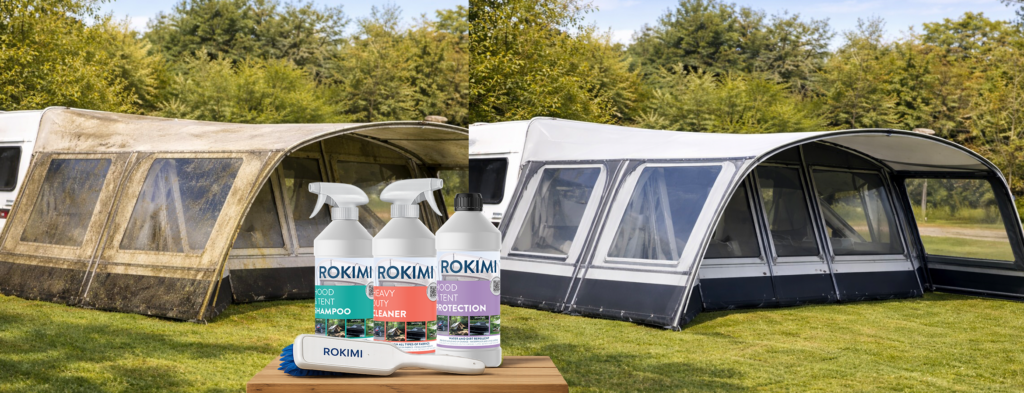
Awning canvas environmentally friendly cleaning without damaging your canvas
Green deposits, mould and dirt are common on awnings. With the Rokimi cleaners, you clean your awning fabric in a safe and environmentally friendly way.
- Removes green deposits, mould and black stains
- Suitable for many types of awning fabric
- Water-based and environmentally friendly
- Developed for technical outdoor fabric
- Simple approach: clean and protect
Common problems with awning fabric
Green deposits / algae
Especially on seams, creases and areas that remain damp for a long time
Fungal spots / black speckles
Often after storage or wet folding
Grey haze / rain streaks
On light cloth and on surfaces where water ‘runs’.
Musty smell
Usually due to moisture remaining in the fabric
Incorporated sand/mud
Scuffs in when rubbed. Loosen first, then clean.
Discolouration by UV
Not always reversible, but you can limit and/or prevent further attack.

Do you recognise this problem?
Stains, green deposits, rain streaks or a grey haze on your awning?
Outdoor textiles require a different approach than ordinary fabric. With Rokimi, you choose a cleaning system tailored to awnings.
Prevent dirt from accumulating, becoming difficult to remove or putting unnecessary strain on the material.
1) Why awnings need special cleaning
Awning fabric cannot be compared to ordinary fabric. Awnings are made of strong outdoor materials such as polyester, acrylic, coated fabrics, cotton or technical fabrics. These materials are designed for intensive outdoor use and must remain strong and functional at the same time.
These materials should:
- water repellency
- withstand sun and rain
- remain flexible during use
An incorrect or overly aggressive cleaner can unnecessarily stress outdoor textiles. Depending on the material and soiling, this can lead to, for example:
- discolouration
- stiffness of the cloth
- degradation of coatings or protective properties
- a less attractive end result
Therefore, it is important to use a product that suits both the type of material and the severity of the soiling.
2) How Rokimi picks up the problems
Rokimi was developed for the cleaning and maintenance of outdoor textiles. Here we distinguish between regular cleaning, more intensive soiling and post-cleaning protection.
Hood & Tent Shampoo
For regular cleaning of tent fabric, awnings, canopies and outdoor covers. The formula focuses on loosening soiling without unnecessarily aggressive cleaning. This makes it particularly suitable as a regular maintenance step for outdoor textiles. Think dust, light deposits, rain streaks, surface dirt and mustiness after storage or a damp period.
- Developed for periodic cleaning of outdoor textiles
- With active substances for loosening soiling
- Suitable for tent fabric, awnings, canopies and outdoor covers
- Fresh fragrance experience to combat musty odours
- pH neutral to slightly alkaline formula approach for regular maintenance
Heavy Duty Cleaner
For more stubborn soiling and more intensive cleaning. When ordinary soiling has built up or moved in deeper, a more vigorous approach is sometimes needed. This step is intended for heavier deposits.
- a strong alkaline component (sodium hydroxide), which can tackle organic dirt, grease and deposits more aggressively;
- an oxidative/chlorine component (sodium hypochlorite), known for bleaching and disinfectant action
- Developed for heavier deposits and deeper cleaning
- Strong action against soiling that is difficult to loosen with regular cleaning
Hood and Tent Protection
As a protective follow-up step after cleaning. After good cleaning, you not only want to get outdoor textiles clean, but also maintain them properly and make sure they remain waterproof and protect them from UV radiation (and drying out). This prevents dirt adhesion and makes maintenance even easier the following year. That is why protection is an important final step in a complete maintenance system. Hood & Tent Protection was developed as the next protective step in the maintenance of awnings. By treating the fabric again after cleaning, you support the protective properties of the material and help prevent dirt, moisture and deposits from adhering.
- After treatment, dirt, green deposits and mould residues do not adhere to the surface as easily, making the fabric cleaner for longer and easier to maintain.
- The protective coating makes the fabric water-repellent again and, depending on the type of fabric and intensity of use, can remain effective for up to about 1 year.
- The formula helps reduce UV interference, thus supporting the maintenance of the fabric's condition, suppleness and longevity.

Quick to the right product

Basic cleaner
For green deposits, dirt and rain streaks.

Stain remover
For stubborn stains such as mould spots, black specks and run-in dirt.

Impregnating agent
Restores water repellency and helps your cloth stay clean longer.
Or to the all-in-one package

Tent cleaning package
Suitable for complete maintenance of the awning fabric
3-step approach
You can use Rokimi in this order: Hood & Tent Shampoo → Heavy Duty Cleaner (for stubborn stains) → Hood & Tent Protection
1) Preparing
- Brush away loose sand and mud (including along seams and zips).
- Wet the cloth well with water to allow the product to work evenly.
- Preferably work in the shade and don't let the canvas dry in between.
2) Cleansing (Shampoo)
- Spray Hood & Tent Shampoo generously on the wet cloth (no need to dilute).
- Rub in with a firm, soft brush and leave on for about 20 min.
- Rinse thoroughly with plenty of water and brush along while rinsing.
- Do you still see stains / mould spots / black specks? Then spray Heavy Duty Cleaner locally, let it work for ± 5 min (do not let it dry), brush in and rinse well again.
Tip: with coloured fabrics, always test on an inconspicuous area first.
3) Protect
- Let the cloth dry completely after cleaning (including seams and edges).
- Apply Hood & Tent Protection liberally and evenly (spray/roller/brush)
- Work wet-in-wet for even results and avoid drips.
- Allow to cure: fabric dry after 1-2 hours, but only fully water-repellent after 12-24 hours.
Please note: do not let protection dry on windows/plastic; wipe off immediately.
Frequently asked questions
Can I use this on coloured fabric?
Yes, but always test on an inconspicuous area first. With some highly pigmented or aged cloths, a spot cleaner may react differently. Always rinse well.
How do I prevent mould after storage?
Clean the cloth, rinse thoroughly and let it dry completely before storing. Store as airy as possible (not in a sealed, damp bag) and avoid prolonged “wet folding”.
How long does it need to dry?
After cleaning: let dry until the cloth is really thoroughly dry (often several hours, depending on weather and cloth). After impregnation: the cloth is usually dust-dry after 1-2 hours, but fully cured after 12-24 hours. Avoid rain during curing.
What if it has metal zips or parts on it?
Avoid prolonged contact of (strong) cleaners with metal. Spray targeted on the substance, work in with brush/sponge and rinse well. Dry metal parts to prevent deterioration.
How many m² do I do with 1 litre?
It depends on cloth type (absorption), texture (rougher vs smooth) and soiling. Roughly calculate: 8-16 m² per litre for regular cleaning/impregnation. On rough or highly absorbent fabrics, you'll be lower.
Do I always have to impregnate?
Not always, but it is highly recommended if you want the fabric to stay beautiful for longer. Impregnation helps against rapid soiling, water absorption and makes future cleaning easier. Prerequisite: the fabric should be clean and dry.