





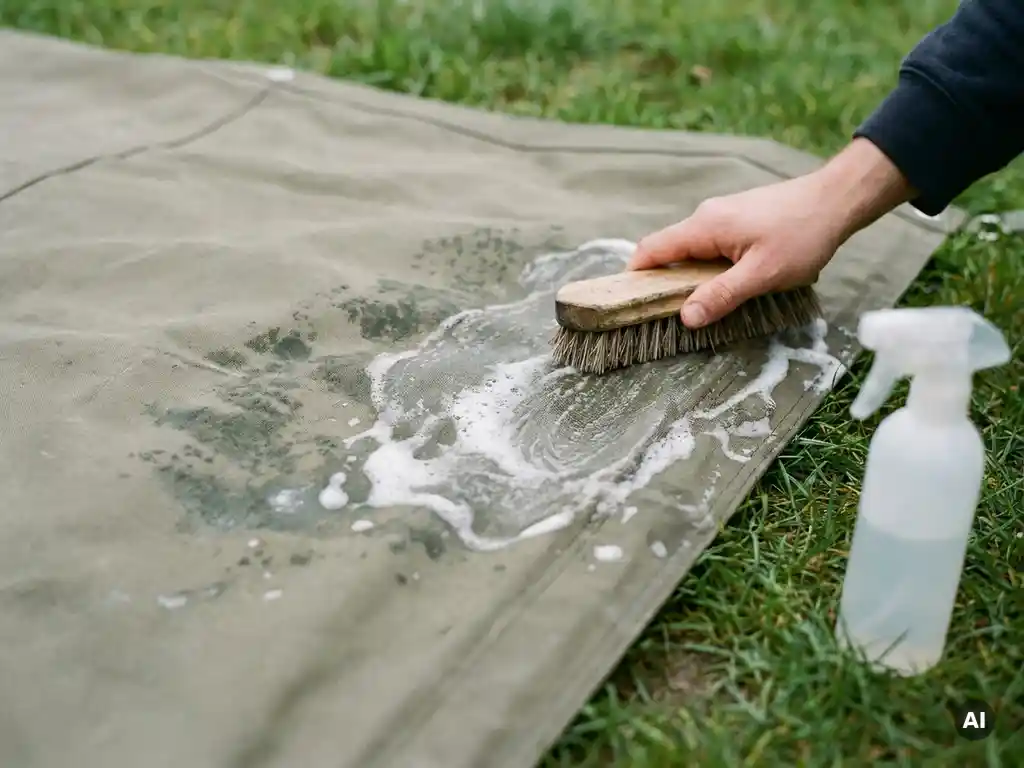
Mould in an awning is a common problem, particularly after a wet summer or a long period of winter storage. The grey or green patches not only look unsightly, but will eventually damage the tent fabric if left untreated. Fortunately, removing mould from an awning is quite straightforward with the right approach and products.
This guide takes you through the process of removing mould from an awning step by step, from the initial pre-treatment to waterproofing after cleaning. Follow the steps in order for the best results.
What you’ll need for cleaning
Make sure you have everything to hand before you start. Nothing is more annoying than realising halfway through that you’re missing a product or tool. To remove mould from tent fabric, you’ll need the following:
- A soft brush or sponge (not steel wool or a hard scouring pad)
- A bucket of clean water
- A garden hose or watering can for rinsing
- A suitable mould remover for tent fabric, such as a heavy-duty cleaner for stubborn stains
- A waterproofing treatment for tent fabric to be applied after cleaning
- Old clothes or gloves to protect your hands
Do not use standard household cleaning products such as bleach or washing-up liquid. These can damage the coating on the tent fabric and permanently impair its water-repellent properties. Always choose products that have been specifically developed for canvas, polyester or nylon tent fabric.
Removing mould and pre-treating the fabric
Start by removing any loose mould before adding moisture. Dry mould is easier to remove than wet mould, and this prevents you from rubbing the spores further into the fabric.
- If possible, pitch the awning fully, or lay the fabric flat on a clean surface outdoors.
- Gently brush the affected areas dry with a soft brush. Work from the outside in so that you do not spread the fungal spores onto a clean cloth.
- Gently shake out the fabric to remove any loose bits.
- Next, apply your cleaning product to the mouldy areas and leave it to work for a short while, following the product’s instructions for use.
After this pre-treatment, you’ll already see the mould stains starting to come away a little. The cleaning product needs time to penetrate the fibres, so don’t skip this waiting period. This makes the next step much more effective.
Ready for your next adventure?
Discover Rokimi’s professional cleaning and protection products and keep your tent fabric, awnings, boat covers and other outdoor equipment looking good for longer.
- ✓ Professional formula
- ✓ Specialist in cleaning & protection
- ✓ Certified quality
Thoroughly cleaning mould patches
Now that the pre-treatment is complete, it’s time to actually remove the mould from the tent fabric. Work systematically and take your time, especially if the mould on the tent fabric is stubborn and has been there for a while.
- Scrub the affected areas in circular motions with a soft brush. Apply light pressure so as not to damage the coating on the fabric.
- If necessary, apply a little extra cleaning product to the most stubborn stains and leave it to work for a few more minutes.
- Rinse the treated area thoroughly with clean water. Make sure no traces of cleaning product remain, as these can damage the fabric over time.
- Check that the mould stains have been completely removed. A second treatment may be necessary for old or deep stains.
After rinsing, check the fabric in daylight. Any remaining discolouration that no longer feels rough to the touch is often no longer active mould but rather a permanent discolouration of the fabric. Active mould feels slightly sticky or powdery to the touch. Repeat the cleaning process if you are in any doubt.
Drying and waterproofing the awning after cleaning
After removing mould from your awning, drying it is a step that many people skip, but which is crucial. An awning that is put away whilst still damp provides the perfect breeding ground for new mould growth.
- Leave the awning to dry completely in the open air. If possible, stretch the fabric out fully so that all the folds and seams can dry properly. Depending on the weather, this will take a few hours.
- Check seams and corners particularly carefully, as that is where damp tends to linger the longest.
- Once dry, apply a waterproofing treatment to the tent fabric. Spray the product evenly and allow it to soak in according to the instructions on the packaging.
- Allow the waterproofing treatment to dry completely before storing the tent or using it again.
Impregnation is not optional after a thorough clean. Washing and scrubbing not only removes dirt and mould, but also strips away part of the fabric’s water-repellent coating. Without a fresh coat of waterproofing, rain will soak through the fabric more quickly, and the risk of new mould growth is greater.
Preventing mould growth in future
Mould in an awning is almost always caused by the same thing: moisture that is unable to evaporate. By adopting a few simple habits, you can prevent this problem from recurring every season.
- Always store your tent in a dry place. Make sure the tent fabric is completely dry before you pack it away, even if you’re in a hurry after a rainy holiday. Unpack the tent again at home to check.
- Store the tent in a dry, well-ventilated place. A damp shed or cellar is not a suitable place to store tent fabric.
- Clean your tent at least once a year. Dirt, leaves and organic matter on the fabric accelerate the growth of mould.
- Apply a waterproofing treatment regularly. A well-treated cloth repels water and dries more quickly, reducing the risk of mould.
- Always let the tent air out for a while after use before you pack it away, even in dry weather.
By taking these preventative measures, your awning will remain in good condition and you won’t have to start all over again with a mould treatment next season.
How Rokimi helps with mould in your awning
At Rokimi, we have developed our products specifically for campers who take their kit seriously. We understand that an awning is a significant investment, and that you want to keep it in top condition for as long as possible. Our product range offers a comprehensive solution for mould on awning fabric:
- Heavy Duty Cleaner for stubborn mould stains and heavily soiled fabrics that require a powerful clean
- Hood & Tent Shampoo for regular cleaning and light soiling; ideal as a post-season maintenance product
- Hood & Tent Protection, the most effective waterproofing treatment of its kind, which, once applied after cleaning, ensures long-lasting water repellency and protection
Our formulas penetrate right into the fibres of the fabric and are suitable for canvas, polyester and nylon. They do not need to be diluted, so you can get started straight away without any hassle. View our full product range to help you make the right choice for your situation, or find out which applications our products are even more suitable. Would you like to find out more or do you have a question? Go to rokimi.com and we’ll be happy to help you.
Everything you need for a clean and protected outdoor lifestyle.
Discover Rokimi’s range of professional cleaning and protection products.
VIEW ALL PRODUCTS →Frequently Asked Questions
Can I remove mould from an awning without pitching the tent?
Yes, that’s possible, but pitching the tent gives by far the best results. If you spread the tent out flat on a clean, hard surface outdoors, you’ll be able to reach most areas easily. The downside is that seams and corners are less accessible, and that the fabric is harder to get completely dry after cleaning. So, if you can, pitch the tent.
What should I do if the mould patches are still visible after two treatments?
If the stains remain after several treatments but no longer feel sticky or powdery, it is likely to be permanent discolouration of the fabric rather than active mould. This is purely cosmetic and poses no immediate risk to the fabric. Active mould that keeps returning despite cleaning often indicates a damp problem in storage; in that case, check that your tent is being stored in a sufficiently dry place.
How far in advance should I start cleaning if I need the awning soon?
Allow at least one full day, preferably two. The cleaning itself takes between one and two hours, depending on the extent of the mould, but drying the fabric can easily take four to eight hours in normal summer weather. The waterproofing agent then also needs time to dry. So never start the evening before you leave; schedule the cleaning at least 48 hours before you plan to use the fabric.
Is it safe to hose down the awning with a high-pressure cleaner after treatment?
No, do not use a high-pressure washer on tent fabric. The powerful jet of water will damage the coating and may affect the seams and seam sealing, causing your tent to leak. A standard garden hose with a gentle spray is more than enough to rinse off any cleaning product residue thoroughly. When rinsing, keep a safe distance and do not use a high-pressure nozzle.
How often should I waterproof my awning, even if there hasn’t been any mould?
As a rule of thumb, you should waterproof your awning at least once a year, preferably at the start or end of the camping season. If you notice that rainwater no longer beads off nicely but soaks into the fabric, then it’s definitely time for a fresh coat, regardless of when you last waterproofed it. Heavy use or a particularly wet season may mean you need to waterproof it more often.
Can I use the same cleaning products on my awning or tent carpet?
That depends on the material. Products such as Rokimi Heavy Duty Cleaner and Hood & Tent Shampoo are suitable for canvas, polyester and nylon – materials that are also found in awnings and some tent carpets. Always check the material of the item you are cleaning first and test the product on a small, inconspicuous area. For specific applications, please consult the product range and the application page at rokimi.com.
What is the best way to store my awning over the winter to prevent mould?
Make sure the tent is completely dry before storing it; check this again when you get home by unpacking the tent once more. Store it loosely rolled up or folded in a breathable bag or sack; never in an airtight plastic bag. Choose a dry, well-ventilated indoor space, such as a heated storage room or loft, and avoid damp cellars or unheated sheds.