


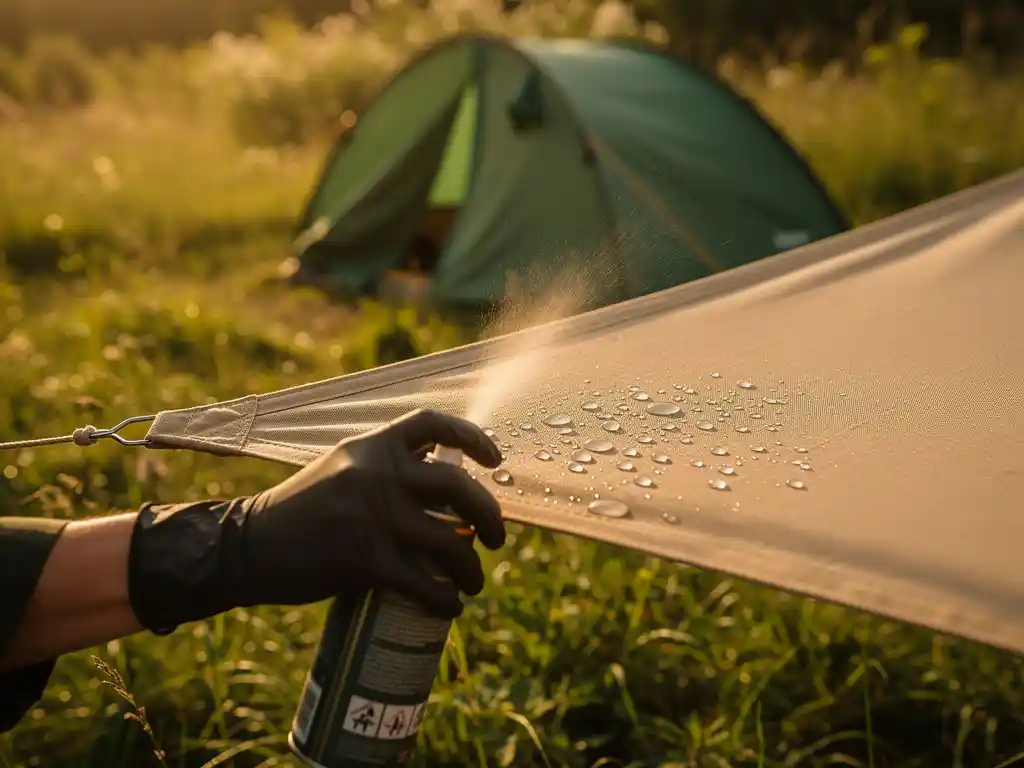
For an average tunnel tent or dome tent with a fabric surface area of around 200 to 300 square centimetres, you will usually need one 500 ml bottle of waterproofing agent. Larger awnings or caravan canopies can easily require two bottles or more. The exact amount depends on the type of tent, the material and the method of application. In this article, we answer the most frequently asked questions about waterproofing tent fabric, so that you know exactly what you need.
What factors determine how much wood preservative you need?
The amount of waterproofing agent required for tent fabric is determined by four factors: the total surface area of the fabric, the type of material, the condition of the fabric and the application technique used. A larger surface area naturally requires more product, but a fabric that is severely worn or porous will also absorb considerably more than a well-maintained tent.
The type of material plays a major role. Canvas is naturally absorbent and soaks up more waterproofing agent than polyester or nylon, which have a denser weave. As a result, a canvas tent typically requires 30 to 50 per cent more waterproofing agent than a comparable polyester tent.
In addition, the application technique makes a difference. Spraying the surface uses less product than rubbing it in or brushing it on, but it also penetrates less deeply into the fibres. For fabric that hasn’t been treated for years, it’s worth taking the time to work the product in thoroughly, so that it really penetrates the fibres and provides long-lasting protection.
How much waterproofing treatment do you need for each type of tent?
The amount required varies greatly depending on the type of tent. A two-person dome tent requires an average of 200 to 400 ml, a family dome tent or tunnel tent requires 400 to 800 ml, and a large awning or caravan canopy can easily require 1 to 2 litres. These are guidelines for an initial treatment on thoroughly cleaned fabric.
- Small dome tent (sleeps 1–2): 200 to 400 ml
- Family tent or tunnel tent (sleeps 4–6): 400 to 800 ml
- Large awning or caravan canopy: 800 ml to 1.5 litres
- Full awning with sleeping compartment: 1.5 to 2 litres or more
Please bear in mind that these are estimates for a thorough initial treatment. If the fabric has already been impregnated and well maintained, half this amount is often sufficient for a re-treatment. For canvas tents, you can use the higher end of the estimate; for modern synthetic materials, the lower end.
Ready for your next adventure?
Discover Rokimi’s professional cleaning and protection products and keep your tent fabric, awnings, boat covers and other outdoor equipment looking good for longer.
- ✓ Professional formula
- ✓ Specialist in cleaning & protection
- ✓ Certified quality
How to correctly apply impregnation agent to tent fabric?
Always apply the waterproofing agent to a clean, slightly damp fabric. Make sure the tent has been thoroughly cleaned first and allow the fabric to dry slightly, but not completely. Then apply the product evenly using a spray bottle, sponge or soft brush, working section by section so that you do not miss any areas.
A step-by-step guide to properly waterproofing a tent looks like this:
- Clean the cloth thoroughly and remove all green deposits, mould and dirt before you start waterproofing.
- Keep the cloth slightly damp but it mustn’t be soaking wet. This helps the waterproofing agent to be absorbed evenly.
- Apply the product evenly in overlapping strokes, working from top to bottom. Pay particular attention to seams, corners and rows of stitching.
- Work the product into the skin using a soft brush or sponge so that it penetrates the fibres properly.
- Leave it to dry completely before you roll up or pack away the tent. It is best to dry it in the open air, out of direct sunlight.
Seams and stitching holes require extra attention when waterproofing canvas. These are the areas where water is most likely to seep in. Apply a second coat to these areas if you want the tent to remain as water-repellent as possible.
How do you know if your tent is sufficiently waterproofed?
A tent is sufficiently waterproofed when water droplets bead up on the surface and roll off rather than being absorbed into the fabric. This beading effect, also known as the lotus effect, is the clearest sign that the waterproofing treatment has worked effectively and that the fabric is water-repellent.
You can easily test this by pouring a small amount of water over the treated fabric once it has dried completely. Do the drops roll off straight away? If so, you’re good to go. Does the water soak into the fabric or form puddles? If so, an extra treatment is needed.
Other signs that the fabric is not sufficiently impregnated:
- The fabric feels heavy when it rains because it absorbs water
- Dark damp patches are visible on the canvas after a rain shower
- The inside of the tent feels damp, even though there is no condensation
- The canvas dries slowly after rain
If in doubt, it’s always wiser to have it treated a second time than to wait until the tent starts causing problems during a camping holiday.
How long does a bottle of wood preservative last?
The number of treatments you can get from a bottle depends on the bottle size and the tent’s surface area. A 500 ml bottle is usually sufficient for one full treatment of a small to medium-sized tent. A 1-litre bottle is enough to treat a large awning or two medium-sized tents.
As regards shelf life: an unopened bottle of impregnating agent will easily remain usable for two to three years if stored correctly. Store the product in a cool, dry place, away from direct sunlight. Once opened, it is best to use the product within one season, although it will keep for longer provided the bottle is kept tightly closed and the product has not dried out.
From a practical point of view, it’s worth checking at the start of the camping season in spring whether you still have enough of the product in stock. That way, you won’t be in for any surprises when you want to freshen up your tent after winter storage and make it water-repellent for the new season.
How Rokimi helps with waterproofing your tent
Here at Rokimi, we have developed a comprehensive range of products specifically designed to keep your camping equipment in top condition. Whether you have a small dome tent or a large awning, we offer the right products for every situation:
- Hood & Tent Shampoo: effectively removes green deposits, dust and light soiling in preparation for waterproofing
- Heavy Duty Cleaner: for stubborn stains, mud and ingrained dirt that ordinary cleaning cannot remove
- Hood & Tent Protection: our most powerful waterproofing treatment, suitable for canvas, polyester and nylon, which provides deep protection for the fabric and makes it water-repellent for the long term
All products are ready to use and do not need to be diluted, so you can get started straight away. They are easy to use for both beginners and experienced campers.
View our full Rokimi's product range and find out which products are best suited to your tent and equipment. Would you like to know what other uses our products are suitable for? Then take a look at our applications page. Or go straight to the Rokimi homepage for further information and to make ordering easier.
Everything you need for a clean and protected outdoor lifestyle.
Discover Rokimi’s range of professional cleaning and protection products.
BEKIJK ALLE PRODUCTEN →Frequently Asked Questions
Do I need to waterproof my tent every year?
That depends on how often you use the tent and in what weather conditions. A tent that is used several times a year or is frequently exposed to rain and sun usually needs to be re-treated annually. If you only use the tent occasionally, treating it every two years may be sufficient. The simplest way to check this is with the water test: pour some water over the fabric and see if it beads up. If not, it’s time to re-waterproof it.
Can I apply the waterproofing treatment even if the tent is already pitched?
Yes, and in many cases this is actually the most practical approach, particularly with large awnings or caravan canopies that are difficult to lay flat. Do make sure the fabric is slightly damp and that you can reach all surfaces evenly, including the underside of the roof and the side walls. Work systematically from top to bottom and allow the tent to dry completely before packing it away.
What is the difference between a spray and a liquid impregnating agent, and which one works better?
Sprays are handy for quick touch-ups and smaller areas, but do not penetrate the fibres as deeply. Liquid products that you work in with a brush or sponge generally offer deeper and longer-lasting protection, particularly on older or porous fabric. For a thorough initial treatment or a tent that hasn’t been waterproofed for some time, a liquid product such as Rokimi Hood & Tent Protection is the better choice.
Can I also use waterproofing treatment for tents on other camping kit, such as an air mattress cover or a rucksack?
Many waterproofing treatments for tent fabric are also suitable for other camping textiles such as rucksacks, flysheets, awnings and even outdoor clothing, provided they are made from similar materials such as polyester, nylon or canvas. Always check the label or product description to confirm which materials are suitable. Rokimi Hood & Tent Protection is suitable for a wide range of outdoor textiles — see the applications page for a full overview.
What should I do if white spots or streaks appear on the fabric after waterproofing?
White spots or streaks usually occur because the waterproofing agent has been applied unevenly or has dried too quickly before it has been properly absorbed. In most cases, these marks will disappear of their own accord after the first rain shower or after the surface has been dampened with a wet cloth. Prevent this problem in future by always applying the impregnating agent in even, overlapping strokes to a slightly damp cloth and by not allowing it to dry in direct sunlight.
Do I need to clean the tent before waterproofing it, and why is that so important?
Yes, thorough cleaning is an absolute prerequisite for an effective waterproofing treatment. Dirt, grease, green deposits and mould residues form a barrier that prevents the waterproofing agent from penetrating the fibres properly, resulting in inadequate and uneven protection. Use a suitable tent shampoo such as Rokimi Hood & Tent Shampoo for general dirt, or the Heavy Duty Cleaner for stubborn stains, and ensure the fabric is thoroughly rinsed before you start waterproofing.
Is it possible to apply too much wood preservative, and what are the consequences of doing so?
Yes, it is possible to apply too much product, which can result in a sticky or stiff fabric, discoloured patches or a longer drying time. In this case, more is not always better: an evenly applied, well-worked-in coat is more effective than a thick, excessive application. If in doubt, it is better to apply two thin coats with sufficient drying time in between, rather than one excessively thick coat in a single application.
Related Articles
- How do you clean a tent fabric after the winter?
- Why does water seep into your tent even though you’ve waterproofed it?
- How do you store tent fabric after waterproofing to ensure it lasts a long time?
- What eco-friendly options are available for maintaining tent fabric?
- What are the best maintenance tips for tent canvas in 2026?