


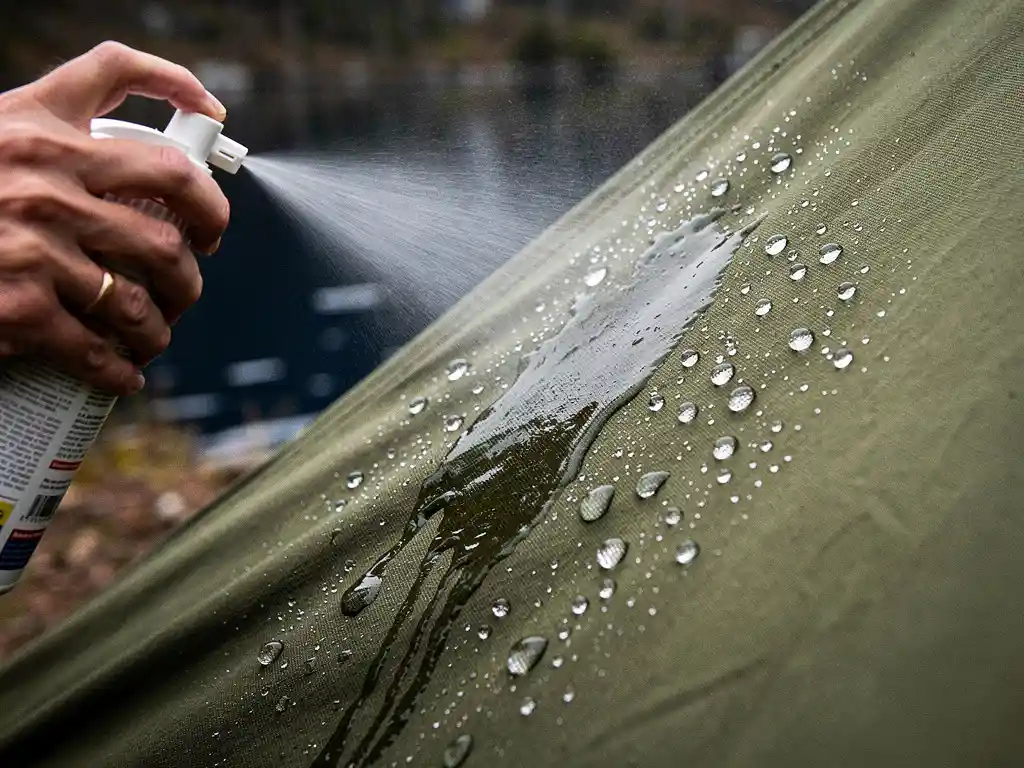
To make canvas water-repellent, treat the fabric after cleaning with a high-quality waterproofing agent specifically designed for canvas. Waterproofing restores the fabric’s water-repellent properties and protects the fibres against rain, moisture and dirt. In this article, we answer the most frequently asked questions about impregnating canvas, from choosing a product to application and maintenance.
Which waterproofing products work best on canvas?
For canvas fabric, fluoropolymer- or silicone-based waterproofing agents work best. These substances penetrate deep into the fibres and create a durable water-repellent layer without compromising the canvas’s breathability. Always choose a product that is specifically formulated for outdoor textiles and is suitable for canvas.
Not all waterproofing products are the same. Cheap, all-purpose sprays often offer only temporary protection and do not penetrate the material deeply enough. Products specially developed for tent fabric and outdoor fabrics are generally more effective because they take into account the structure and porosity of the canvas. When purchasing, bear the following points in mind:
- Suitable for canvas, polyester and other outdoor materials
- Penetrates deep into the fibres – not just a surface coating
- Ready-to-use formula that does not need to be diluted
- Long-lasting protection, even with intensive outdoor use
A waterproofing spray for tents is handy for smaller surfaces, but for larger canvases such as awnings or canopies, a liquid product applied with a sponge or brush is often more effective. This ensures an even distribution across the entire surface.
Do you need to clean the canvas first before waterproofing it?
Yes, you should always clean canvas thoroughly before waterproofing it. Dirt, green deposits, grease and other contaminants block the fabric’s pores and prevent the waterproofing agent from being properly absorbed. If you waterproof a dirty canvas, you’ll end up applying the protective layer on top of the dirt rather than into the fibres themselves.
This is a step that many people skip, but it makes a huge difference to the end result. A clean cloth absorbs the impregnating agent much better, resulting in deeper and longer-lasting protection. For regular cleaning, use a mild cloth shampoo suitable for canvas. For stubborn stains, mud or ingrained grime, you’ll need a more powerful cleaner that works deep into the fibres.
After cleaning, it is important to ensure that the canvas is completely dry before applying the waterproofing agent. A damp canvas can dilute the agent and adversely affect its adhesion. It is best to leave the canvas to dry in the open air on a dry, windless day.
Ready for your next adventure?
Discover Rokimi’s professional cleaning and protection products and keep your tent fabric, awnings, boat covers and other outdoor equipment looking good for longer.
- ✓ Professional formula
- ✓ Specialist in cleaning & protection
- ✓ Certified quality
How do you apply a waterproofing agent to canvas correctly?
Apply a waterproofing agent to the canvas by spreading the product evenly over the clean, dry fabric using a sponge, brush or spray bottle. Work in sections and make sure you don’t miss any areas. Allow the product to soak in according to the instructions on the packaging and let the canvas dry completely before storing or using it.
Follow these steps for the best results:
- Clean the cloth thoroughly and remove all dirt, grime and stains.
- Leave the canvas to dry completely, preferably outdoors.
- Apply the waterproofing agent on the dry cloth, spread evenly over the entire surface.
- Work from top to bottom so that the product does not drip onto any areas that have already been treated.
- Allow the product to be absorbed and left to dry for the recommended drying time.
- Check after drying Check whether the water-repellent finish works properly by dropping a few drops of water onto the fabric.
It is best to carry out the work on a cloudy day without direct sunlight. Bright sunshine can cause the impregnating agent to dry too quickly before it has been properly absorbed. You should also avoid working in high humidity or when rain is forecast.
How long does canvas remain water-repellent after impregnation?
After impregnation, canvas remains water-repellent for an average of one to two seasons, depending on how intensively it is used and exposed to sun, rain and wind. Tents and awnings that are used regularly will need re-treatment sooner than materials that are used less frequently.
There are a number of factors that affect the lifespan of the impregnation:
- Use and exposure: The more the fabric is used and exposed to the elements, the faster the protective layer wears away.
- Cleaning: Washing and scrubbing can damage the waterproofing. After intensive cleaning, it is advisable to reapply the treatment.
- Storage: Canvas that is stored in a dry and clean place retains its waterproofing for longer than canvas that is stored whilst damp.
- Product quality: Professional wood preservatives last longer than cheaper alternatives.
A good rule of thumb is to check the fabric every spring and, if necessary, re-waterproof it in preparation for the new camping season. That way, you’ll always be well protected as the season begins.
Why does my canvas no longer repel water after treatment?
If a canvas fabric does not repel water after impregnation, the impregnating agent has probably not been able to penetrate properly. The most common causes are a fabric that has not been cleaned thoroughly, a surface that was too damp during application, or a product that is not suitable for the type of material.
If the waterproofing is not working, check the following points:
- Was the cloth clean enough? Grease, soap residue or green deposits can prevent the impregnating agent from adhering properly.
- Was the cloth dry? Moisture in the canvas dilutes the treatment and hinders its penetration into the fibres.
- Is the product suitable for canvas? Some water-repellent treatments are only effective on synthetic materials such as polyester and nylon.
- Has the drying time been observed? Storing or using the product too soon may damage the impregnation before it has fully cured.
In most cases, it helps to clean the canvas again, allow it to dry thoroughly and reapply the waterproofing treatment using a suitable product. Sometimes a second coat is needed for heavily worn or old canvas where the fibres have dried out more deeply.
Can you make any canvas water-repellent?
Virtually any canvas can be made water-repellent using the right impregnating agent, even if its original water-repellent properties have completely worn off. Even heavily aged or weathered canvas responds well to a high-quality treatment, provided the fabric is still structurally sound and there are no tears or damage.
There are, however, limits. Canvas that has been physically damaged by mould which has penetrated deep into the fibres, or fabric that has been structurally damaged by long-term neglect, benefits less from impregnation. In such cases, cleaning with a powerful detergent is the first step towards restoring the material as effectively as possible prior to treatment.
New canvas products often come with a factory-applied waterproofing treatment, but this wears off over time. Regular maintenance – involving cleaning followed by waterproofing – significantly extends the life of the fabric and prevents you from having to replace your expensive equipment prematurely.
How Rokimi helps with canvas waterproofing
Here at Rokimi, we have developed a comprehensive range of products specifically designed for the care of canvas, polyester and nylon outdoor fabrics. Whether you want to treat an awning, canopy or boat cover, our products offer a complete care cycle, from cleaning to protection:
- Hood & Tent Shampoo: The most powerful fabric shampoo for regular cleaning of green deposits and light soiling. Ready to use, no dilution required.
- Heavy Duty Cleaner: For stubborn stains, mud and ingrained dirt that has penetrated deep into the fibres. Ideal as a preparatory step before waterproofing.
- Hood & Tent Protection: The most effective waterproofing treatment of its kind, which makes the cleaned fabric optimally water-repellent and provides long-lasting protection against rain and damp.
All products are ready to use without dilution and are suitable for both experienced campers and beginners. View our full product range or find out which applications our products are suitable. Would you like to find out more or place an order straight away? Then visit rokimi.com and take the first step towards ensuring your tent fabric is fully protected.
Everything you need for a clean and protected outdoor lifestyle.
Discover Rokimi’s range of professional cleaning and protection products.
BEKIJK ALLE PRODUCTEN →Frequently Asked Questions
How often should I waterproof my canvas if I use it a lot?
If you use your canvas cover intensively – for example, on several camping trips per season or if it is exposed to rain and sun for long periods – it is advisable to waterproof it at least once a season. A handy way to check whether re-treatment is needed is to drop a few drops of water onto the fabric: if the water no longer beads up and rolls off but is absorbed into the material, it’s time for another treatment. Always treat the fabric in the spring, before the camping season begins, so that you’re fully protected when you set off.
Can I waterproof my canvas without washing it first?
This is strongly discouraged. Dirt, grease and green deposits block the pores of the canvas, preventing the impregnating agent from penetrating deep enough into the fibres and causing it to adhere only to the surface of the dirt. The result is weak, short-lived protection that quickly flakes off or washes away. Always clean the canvas thoroughly with a suitable canvas shampoo or a powerful cleaner for stubborn dirt, and allow it to dry completely before applying the waterproofing agent.
Is there a difference between a waterproofing spray and a liquid waterproofing product, and which one should I choose?
Yes, there is a practical difference between the two application methods. An impregnating spray is handy for small surfaces, hard-to-reach seams or a quick touch-up whilst out and about. A liquid waterproofing agent applied with a sponge or brush is better suited to large canvas areas such as awnings, canopies or boat covers, as it allows you to apply a more even and thicker layer. For the best and most long-lasting protection on large canvas surfaces, it is best to opt for a liquid product.
Can I wash my canvas in the washing machine before I waterproof it?
For most canvas items, such as awnings, canopies and boat covers, machine washing is not suitable due to their size and construction. Furthermore, machine washing can damage the coating and seams of the fabric. Instead, use a mild fabric shampoo and wash the canvas by hand or with a soft brush. Smaller canvas items such as chair covers or bags may sometimes be machine-washable, but always check the manufacturer’s care label before doing so.
What is the difference between water-repellent and waterproof, and does impregnation really make my fabric waterproof?
This is a common misconception: impregnation makes canvas water-repellent, but not completely waterproof. Water-repellent means that water beads up and rolls off the surface, and the fabric does not become saturated quickly. Waterproof means that no water can penetrate it, regardless of the pressure or duration of exposure. Canvas is naturally a breathable material and is better protected against rain and moisture by impregnation, but in the event of extreme rainfall or prolonged exposure, some moisture may still penetrate. Regular maintenance and high-quality impregnating agents maximise protection as much as possible.
How should I store my canvas after waterproofing it to ensure it remains protected for as long as possible?
Always store your canvas clean, dry and fully cured in a dry, well-ventilated place, away from direct sunlight and moisture. Never store the canvas whilst damp, as this encourages mould growth and damages the impregnation. Roll the canvas up loosely rather than folding it tightly to prevent creasing and damage to the impregnation layer. A breathable storage bag or cover is ideal, as plastic bags can trap moisture and encourage mould growth.
Can I also use a canvas waterproofing treatment on other outdoor materials such as polyester or nylon?
Many high-quality waterproofing products suitable for canvas also work well on polyester and nylon, but always check the product description before applying it to a different material. Formulations specifically designed for outdoor textiles are generally suitable for use on a wide range of fibre types. However, never use a product intended exclusively for synthetic materials on canvas, as this may damage the fibres or leave an undesirable coating that impairs the canvas’s breathability.
Related Articles
- How long does waterproofing remain effective on tent fabric?
- What should you do if your tent fabric is no longer evenly waterproof?
- How do you treat tent fabric after contact with salt water?
- What are the consequences of poorly maintained tent canvas?
- What concentration of impregnating agent do you use for tent canvas?