


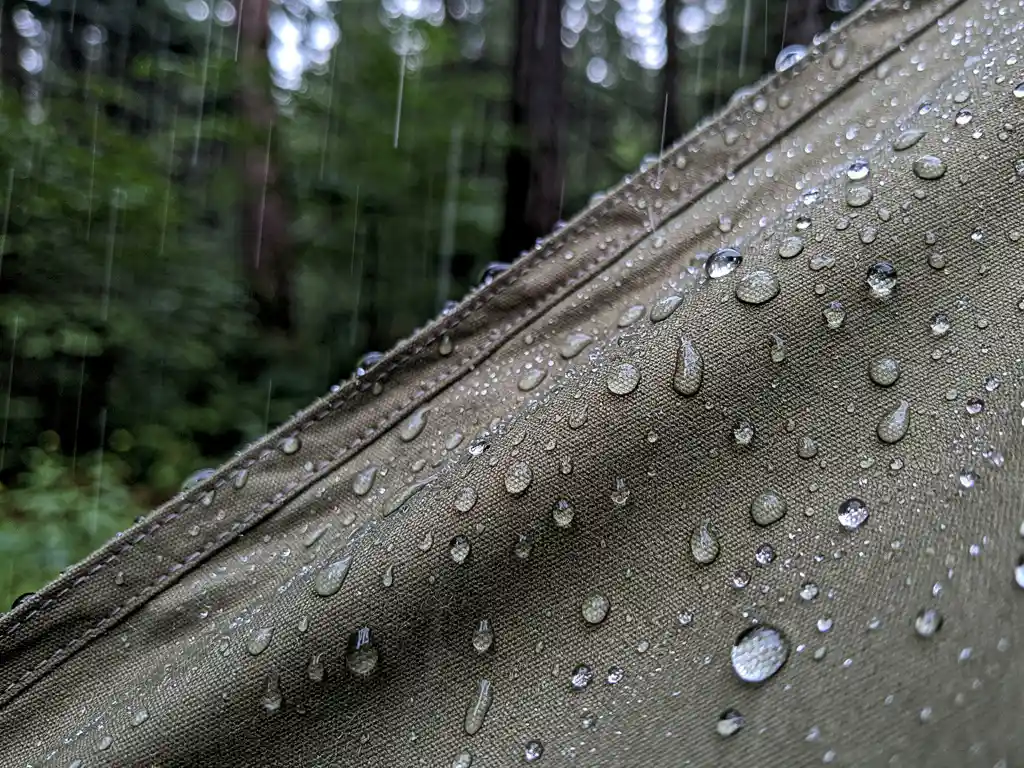
Rain on freshly waterproofed tent fabric isn’t usually a disaster, but the timing makes a big difference. If the fabric isn’t completely dry when it rains, the waterproofing treatment may be washed out before it has fully set. Read on to find out how long you should wait, what to do if things do go wrong, and how to check the result.
How long does impregnated tent fabric need to dry before it starts to rain?
Under normal summer weather conditions, impregnated tent fabric has a minimum 2 to 4 hours It is necessary to allow sufficient time for drying before the rain can no longer cause any damage. In cool or cloudy weather, high humidity or light winds, this drying time can be as long as 6 to 8 hours. The longer the fabric can remain dry, the better the waterproofing will set into the fibres.
The reason is that impregnating agents based on fluoropolymers or silicones undergo a chemical process in which the active ingredients bond to the fibres. This process requires time and heat. As long as the agent still feels liquid or sticky, it is susceptible to being washed off. Once the fabric feels dry and is no longer sticky, the most critical phase is over.
A practical rule of thumb: plan to apply the waterproofing on a day with at least half a day of dry, and preferably sunny, weather. A light breeze speeds up the drying process considerably. Avoid waterproofing in the evening if dew or mist is forecast overnight, as this also counts as moisture that can interfere with adhesion.
What happens when rain falls on a freshly impregnated fabric?
If rain falls on a freshly impregnated fabric whilst the impregnation has not yet set, some of the active ingredient will be washed away. The fabric will then lose some of its water-repellent properties, or the protection will be unevenly distributed across the surface. In the worst-case scenario, the result is similar to that of an untreated fabric.
The severity of the damage depends on three factors:
- How long the cloth had been drying before the rain started. After 1 hour, adhesion is minimal; after 3 hours, some of the product has already set.
- The intensity of the rain. A light drizzle causes less damage than a heavy downpour.
- The type of wood preservative. Some formulations are water-based and more susceptible to early contact with water; others are more robust.
One visible consequence of the fabric being exposed to rain too early is that it becomes water-repellent in places. In some areas, water droplets roll off easily, whilst in others the water is absorbed straight away. This is a clear indication that the treatment has not taken effect uniformly.
Ready for your next adventure?
Discover Rokimi’s professional cleaning and protection products and keep your tent fabric, awnings, boat covers and other outdoor equipment looking good for longer.
- ✓ Professional formula
- ✓ Specialist in cleaning & protection
- ✓ Certified quality
Can you waterproof a tent if rain is forecast?
You can waterproof a tent if rain is forecast, but only if you’re certain the fabric will have had enough time to dry before the rain starts. If rain is expected that afternoon and it’s only 10 o’clock in the morning, there’s plenty of time provided the weather holds. If the shower is forecast for two hours’ time, you’re better off waiting.
Check the hourly weather forecast rather than the daily forecast. Apps that show the chance of precipitation on an hourly basis give you a more realistic picture of the available time window. Also bear in mind dew in the early morning or evening, as technically speaking this is also precipitation that can interfere with the impregnation process.
If the weather conditions are uncertain, it is wiser to postpone impregnating the fabric until a day when the weather is stable. A treatment carried out under time pressure and subsequently affected by rain provides less protection than a treatment that has been allowed to cure properly. It is always better to do something properly once than to do it half-heartedly twice.
How can you tell if the waterproofing has been properly absorbed after it has rained?
The simplest test is the water bead test: splash a small amount of water onto the treated fabric. If the water immediately forms round droplets that roll off the surface, the waterproofing has been properly absorbed. If the water is absorbed or spreads like a stain, the protection is insufficient or has been applied unevenly.
Carry out this test in various places on the fabric, as the adhesion may be uneven following early exposure to rain. Pay particular attention to the seams, the eaves and areas that are more exposed to direct water. These are the areas where insufficient waterproofing will become apparent most quickly.
Another indicator is the feel of the fabric. Well-impregnated canvas or polyester feels slightly stiff and has a slightly waxy surface. Fabric that has lost its protective coating feels softer and absorbs water more quickly. Combine both tests to make a reliable assessment of the quality of the treatment.
Do you need to re-waterproof the fabric if it has got wet whilst drying?
Yes, if the fabric has got wet from rain whilst it was drying and the water beading test subsequently fails, you’ll need to re-waterproof it. There is no way to restore a washed-out waterproofing treatment without reapplying the product. Fortunately, the fabric does not need to be cleaned again first, provided it is already clean.
Allow the fabric to dry completely before re-impregnating it. A damp fabric absorbs the impregnating agent less effectively, which will simply cause the same problem to recur. Wait for a dry day with stable weather and allow sufficient drying time, then reapply the agent evenly.
If the impregnation has taken well in some places but not in others, you can also touch it up locally. Apply the product only to the areas where the water beading test showed an unsatisfactory result. This way, you’ll use less product and won’t need to re-treat the entire fabric. After touching up, the drying time is the same as for a full treatment.
How Rokimi helps with waterproofing tent fabric
At Rokimi, we understand that waterproofing tent fabric involves more than simply buying a product and hoping it works. Good timing, the right preparation and a reliable product all play a part in determining the result. That’s why we offer products and information to help campers protect their kit properly.
- Hood and Tent Protection is our most effective waterproofing treatment for canvas, polyester and nylon. The formula penetrates deep into the fibres and creates a long-lasting water-repellent layer that can withstand changeable weather.
- The products are ready to use and do not need to be diluted, making them easy and foolproof to apply for both beginners and experienced campers.
- For the best possible care results, combine the Hood & Tent Protection with our Hood & Tent Shampoo for regular cleaning or the Heavy Duty Cleaner for stubborn stains, so that you’re always applying the waterproofing to a clean and properly prepared fabric.
Would you like to know which product is best suited to your tent or awning? Take a look at our full product range or find out which applications our equipment is suitable. Want to find out more about the right approach for your kit? Go to the Rokimi website for practical tips and advice.
Everything you need for a clean and protected outdoor lifestyle.
Discover Rokimi’s range of professional cleaning and protection products.
BEKIJK ALLE PRODUCTEN →Frequently Asked Questions
Can I waterproof my tent even if the fabric is still slightly damp from dew?
No, it is strongly advised against applying a waterproofing treatment to a fabric that is still damp from dew or morning moisture. Moisture in the fibres prevents the waterproofing agent from bonding properly, meaning it cannot penetrate effectively and the protection remains superficial. Always allow the fabric to dry completely — check this by running your hand over the fabric — before you start waterproofing.
How often should I re-impregnate my tent?
That depends on how often you use the tent and the weather conditions to which the fabric is exposed. As a rule of thumb, re-waterproof the tent as soon as the water beading test shows that water no longer beads off properly, or at least once a season if used regularly. Tents that are frequently pitched and taken down, or that are left in the sun for long periods, lose their water-repellent properties more quickly than tents that are used sparingly.
Does it matter whether I use a spray bottle or a liquid waterproofing agent for tent fabric?
Both methods can be effective, but a spray bottle is more practical for large surfaces such as tent fabric, as it allows you to apply the product quickly and evenly. Liquid products that you rub in or brush on are better suited to targeted treatment of seams or specific areas. With both methods, make sure you cover the entire surface evenly, as any missed spots will quickly become visible as soon as the fabric gets wet.
What is the most common mistake made when waterproofing a tent?
The most common mistake is applying the waterproofing treatment to a dirty or poorly prepared fabric. Dirt, algae or soap residue block the fibres and prevent the waterproofing agent from adhering properly, resulting in uneven or short-lived protection. Always clean the fabric thoroughly with a suitable tent shampoo and allow it to dry completely before applying the impregnating agent — this preparation largely determines the end result.
Can I speed up the impregnation process using a hairdryer or a heat gun?
Careful use of a hairdryer on a low heat setting can speed up the drying process slightly, but a heat gun is too risky as the high temperature can damage or distort synthetic fibres such as nylon or polyester. The safest and most effective method remains drying the fabric in the open air in sunny weather with a light breeze. If you’re in a hurry, choose a day with favourable weather conditions rather than using artificial heat.
Does waterproofing also work on old or worn tent fabric?
Impregnation can restore the water-repellent layer of old tent fabric, but it does not solve structural problems such as thin spots, small tears or a damaged coating. If the fabric becomes saturated in light rain despite having been properly treated, the coating on the inside may be worn — something that impregnation cannot repair. Before treating the fabric, check the condition of the fabric and the seams, and if there is severe wear and tear, consider whether repair or replacement might be a better option.
Do I also need to treat the seams of my tent separately after waterproofing it?
Yes, seams are inherently vulnerable because the needle holes form small openings through which water can penetrate, even if the fabric itself is well-impregnated. After waterproofing, treat the seams with a seam sealer or apply an extra layer of waterproofing agent specifically to the seams. This applies particularly to the roof seam and the joints between the floor and the wall, as these are the areas that bear the brunt of the pressure when it rains.
Related Articles
- Step-by-step guide: removing bird droppings without damaging the tent fabric
- What is the difference between fluorine-free and traditional wood preservative?
- What are the differences between spray and liquid impregnating agents?
- What are the benefits of professional impregnation products?
- What concentration of impregnating agent do you use for tent canvas?