


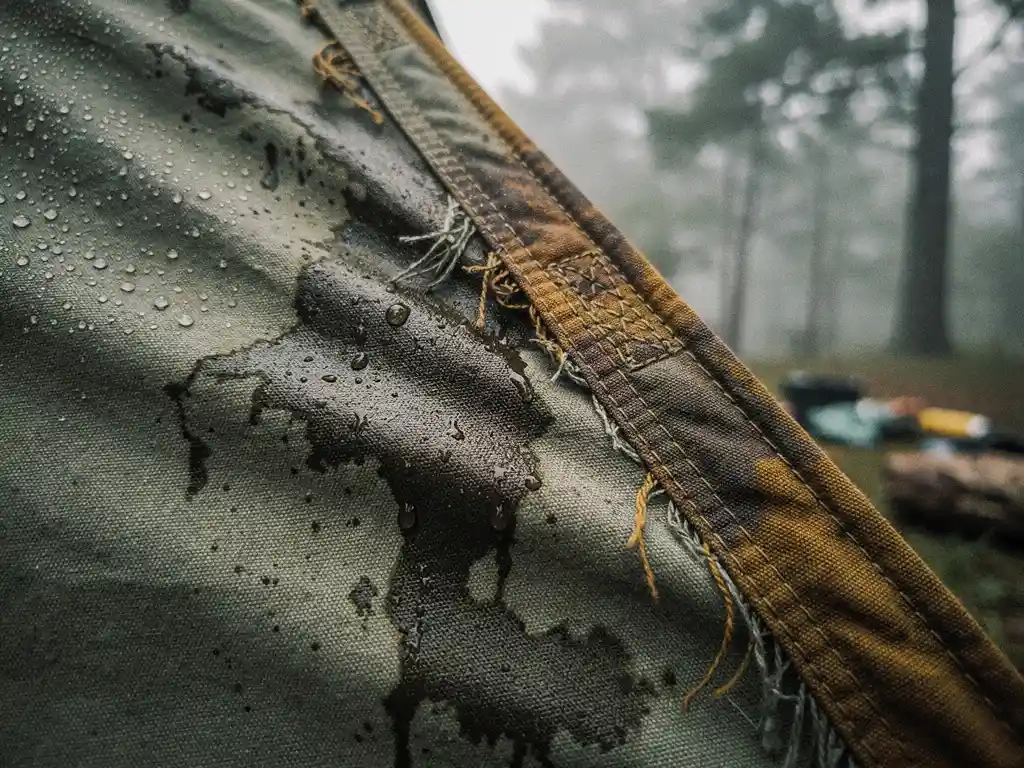
Your tent fabric needs to be waterproofed as a matter of urgency as soon as water no longer beads on the surface but soaks straight into the fabric. This is the most reliable sign that the water-repellent coating has worn away. In this article, we answer the most frequently asked questions about recognising, testing and dealing with worn-out waterproofing.
How does waterproofing actually work on tent fabric?
Waterproofing works by applying a thin, water-repellent layer to the fibres of the tent fabric. This layer ensures that water droplets clump together and roll off the surface rather than being absorbed into the material. The fabric itself is not made waterproof, but the surface structure is treated in such a way that water cannot gain a grip on the fibres.
Most modern waterproofing agents contain fluorinated or silicone-based compounds that bond to the individual fibres of the fabric. Once the treatment has been absorbed and has dried, it forms a microscopically thin protective layer. This layer is not visible to the naked eye, but it is definitely present and active.
It is important to understand that impregnation is not the same as waterproofing. A well-impregnated fabric keeps water out thanks to surface tension. When that protective layer breaks down due to use, washing or UV radiation, the water-repellent effect also gradually disappears.
What are the visible signs that a tent fabric is no longer water-repellent?
The clearest sign that your tent fabric is no longer water-repellent is that rainwater leaves dark stains or wet patches on the fabric instead of rolling off as droplets. You’ll notice this straight away when it rains: the fabric soaks up the water and visibly changes colour. Campers often refer to this as the fabric “getting wet”.
As well as water absorption, there are other tell-tale signs:
- The fabric feels heavy and damp to the touch after rain, even if there is no leak
- The inside of the tent feels damp because moisture seeps through the fabric
- Puddles or soggy patches are forming on the roof of the tent or awning
- The canvas is drying slowly and retains a musty smell for a long time
- Green deposits or mould appears more quickly in places that remain damp
These signs do not always appear at the same time. Sometimes it starts at a single corner or a specific part of the roof, indicating that the waterproofing has worn unevenly. This is normal, as certain areas are exposed to more sun, rain and mechanical wear than others.
When is it too late to just apply a waterproofing treatment?
It is too late to simply apply a waterproofing treatment if the fabric is also dirty, mouldy or affected by green deposits. This is because a waterproofing agent only adheres properly to a clean and dry surface. If you apply the waterproofing to a dirty fabric, you will simply seal the dirt in and achieve hardly any protective effect.
In practice, this means that cleaning must always be carried out before re-impregnation. If the fabric is only slightly soiled, a thorough clean using a suitable tent shampoo will suffice. For stubborn stains, ingrained mud or black streaks, a more powerful cleaner is needed that penetrates deep into the fibres. Only then does waterproofing make sense.
There is also a situation where waterproofing simply no longer helps: when the fabric is structurally damaged. Tears, thin spots or a coating that has deteriorated due to long-term neglect cannot be repaired with an impregnating agent. In such cases, replacing the fabric or the tent is the only option.
How often should you re-impregnate tent fabric?
As a rule of thumb, your tent fabric should be re-waterproofed once or twice a year. For campers who use their tent or awning extensively, it is advisable to do this at the start and end of the season. Those who only go camping a few weekends a year can usually get by with just one treatment a year.
The correct frequency depends heavily on a number of factors:
- Intensity of use: The more often you go camping, the faster the waterproofing wears off
- Exposure to the sun: UV radiation causes the water-repellent layer to deteriorate more quickly
- How often you wash the cloth: Washing gradually removes the waterproofing layer
- Type of material: Some fabrics lose their protective properties more quickly than others
The most reliable method is not to stick to a fixed schedule, but to test the water-repellency regularly. That way, you only treat the fabric when it’s really necessary.
What is the difference between a wet and a dry impregnation test?
In the wet waterproofing test, you sprinkle water onto the tent fabric and check whether the droplets bead up. On a properly waterproofed fabric, the droplets roll off immediately. In the dry test, you assess the fabric visually and feel the surface for roughness or absorbency without using water. The wet test is more reliable and provides a more direct indication of the actual water-repellency.
Here’s how to carry out the wet test correctly:
- Make sure the cloth is clean and dry
- Sprinkle a small amount of water onto the surface
- Check whether the water beads up and runs off, or whether the cloth absorbs the water
- Test in several places, including the roof and the sides
The dry test is useful as a quick visual check, for example after storage. If the fabric feels rough or porous, or if you can already see water-absorption marks from a previous rain shower, this is an indication that waterproofing is required. However, always confirm this with the wet test before you start.
Which types of fabric lose their water-repellent properties more quickly?
Canvas loses its water-repellent treatment more quickly than polyester or nylon, particularly when it gets wet regularly and dries slowly. The thicker, more absorbent structure of canvas makes it more prone to retaining moisture and, consequently, to a faster breakdown of the water-repellent layer. Polyester and nylon are naturally less absorbent and retain their water-repellent treatment for longer.
There are also differences within the canvas category. Untreated or lightly treated canvas requires more frequent maintenance than coated canvas. Furthermore, awnings and canopies that are left outside permanently lose their water-repellent properties more quickly than tents that are only used during camping weekends. Prolonged exposure to sun, wind and rain is the biggest factor in the wear and tear of any type of fabric.
Nylon has its own point to bear in mind: it is lightweight and quick-drying, but the coating can degrade more quickly with intensive use or incorrect storage (storing whilst damp). With polyester, UV radiation plays a greater role in the accelerated breakdown of the impregnation layer than with canvas.
How Rokimi helps with waterproofing your tent fabric
We understand that looking after your tent fabric can sometimes be confusing, especially if you’re not sure which product to use and when. That’s why we offer a complete range of care products to guide you step by step, from cleaning to protection:
- Hood & Tent Shampoo: for regular cleaning of green deposits and light soiling, in preparation for waterproofing
- Heavy Duty Cleaner: for stubborn stains, ingrained dirt and deposits that require a more powerful approach
- Hood & Tent Protection: the most effective waterproofing treatment of its kind, suitable for canvas, polyester and nylon, which makes your fabric optimally water-repellent
All products are ready to use, do not need to be diluted and are suitable for both experienced campers and beginners. They penetrate right into the fibres to provide thorough, long-lasting protection. View our full Rokimi's product range and find out which products are best suited to your tent or awning. Would you like to know more about the materials and situations we support? Then take a look at our applications or go directly to the Rokimi homepage for an overview of everything we offer.
Frequently Asked Questions
Can I waterproof my tent fabric whilst it’s still wet?
Het is sterk af te raden om impregnering aan te brengen op een nat doek. De meeste impregneermiddelen hechten het beste op een schoon én droog oppervlak, zodat de werkzame stoffen diep in de vezels kunnen trekken. Een uitzondering hierop zijn speciaal ontwikkelde ‘wet-on-wet’ sprays, maar ook dan geldt: lees altijd de productinstructies zorgvuldig voor gebruik.
What is the difference between a spray and a liquid waterproofing agent, and which one works better on tent fabric?
Spray products are useful for small areas or for treating specific spots, such as seams or corners. Liquid waterproofing products, which you apply with a sponge or cloth, generally offer deeper and more even protection for large surfaces such as an entire tent roof or awning. For the best results on large fabrics, a liquid product such as Rokimi Hood & Tent Protection is the better choice.
How long should I wait after impregnation before I can use my tent again?
After applying the waterproofing treatment, the fabric must be allowed to dry completely before you pitch or pack away the tent. Depending on the temperature, humidity and the product used, this usually takes between 2 and 24 hours. It is best to dry the fabric outdoors or in a well-ventilated area, and avoid direct sunlight during the first few hours to ensure it dries evenly.
Can I also use waterproofing treatment on the seams and zips of my tent?
Yes, seams and zips deserve extra attention when waterproofing, as these are the weakest points where water penetrates most quickly. Apply the waterproofing treatment to and around the seams as well. For zips, you can also use a special zip wax or spray to keep them running smoothly and prevent moisture from seeping in.
My tent is still new — do I need to waterproof it already?
A new tent usually comes with a factory-applied waterproofing treatment, but this is not always optimal or sufficient for intensive use. It is a good idea to test a new tent with the wet water test before your first proper camping weekend. If the droplets are absorbed after just a few minutes rather than rolling off, an initial treatment with a waterproofing agent is definitely recommended.
What should I do if my tent fabric still absorbs water after being waterproofed?
If the fabric still absorbs water after waterproofing, there are two common causes: the fabric was not cleaned thoroughly enough before treatment, or the waterproofing agent has not been fully absorbed and dried. Clean the fabric again using a suitable tent shampoo or a stronger cleaner, allow it to dry completely, and then apply a second coat of waterproofing agent. Unfortunately, if the fabric is structurally damaged, waterproofing will no longer be effective.
What is the best way to store my tent fabric to ensure the waterproofing lasts as long as possible?
Always store your tent when it is dry and clean, preferably loosely folded or rolled up in a breathable bag — never in an airtight plastic bag. Storing it whilst damp is the quickest way to damage both the waterproofing and the fabric. Store the tent in a cool, dry place out of direct sunlight, and check the fabric again at the start of each season using the wet waterproofing test.
Related Articles
- Wat is het verschil tussen canvas en polyester bij het impregneren?
- How do you waterproof a camping chair or a awning?
- Can you waterproof a tent in the washing machine?
- How do you store tent fabric after waterproofing to ensure it lasts a long time?
- How long does it take to impregnate tent fabric properly?